The Toyota Tax is Real
I ran the numbers on 25 used car brands. Honda quietly beats Toyota on reliability-per-dollar. Mercedes is dead last by a country mile. Here's the full ranking, and what surprised me.
Reliability is sexy. We love it. But at the end of the day, reliability is mostly about spending less money on your car in the future. So why aren't we talking about the RROI (Reliability Return On Investment) of brands?
Everyone says Toyota is the most reliable used car brand. The data agrees, sort of. But there's a catch nobody talks about: you're paying a premium for a name that's nearly indistinguishable from a Honda on actual reliability scores. Now don't get me wrong, I love Toyota, and drive a good old 94 Hilux Surf myself (basically a cooler 4Runner, if ykyk). I've been a Toyota loyalist for years. But that loyalty is exactly what made me want to do this analysis. I had a hunch the Japanese reliability story was real, and a hunch the Toyota tax was real too, and I wanted to find out whether my brand loyalty was backed by data or just sentiment. After personally buying and selling many used cars over the years, and helping dozens of friends and family do the same, I figured it was time to actually check.
The result is one of the more interesting used-car rankings I've seen, and it doesn't match the conventional wisdom. The cars people think are the safest buys aren't always the smartest buys. And the cars people avoid out of habit sometimes outperform on the numbers that actually matter.
The Methodology
I took two public datasets and put them next to each other:
- Reliability scores come from VMR's Owner Reliability Survey. Thousands of owners rating their cars from "poor" to "excellent." Scores run 0 to 4. Lexus tops it at 3.67, Volkswagen scrapes the bottom at 2.67.
- Price data comes from CarGurus.ca's brand-level average prices, which represent the average asking price across all listings for a given brand at the time of writing.
I normalized both metrics to a 0-100 percentile within the dataset. Most-reliable brand gets a 100 on reliability. Cheapest brand gets a 100 on affordability. Then I averaged the two to get a combined "value-per-reliability" score.
It's not perfect. Two caveats worth being upfront about:
- Brand-level prices include the whole lineup. Toyota's average gets pulled up by 4Runners and Tacomas; Hyundai's gets pulled down by Elantras. Some of the "expensive vs cheap" gap is product mix, not pure price-for-quality.
- Brand-level reliability hides model variation. A Honda Civic is more reliable than a Honda Pilot V6. A Ford F-150 is more reliable than a Ford Focus. The brand score is an average. Pick the model carefully.
That said, when you're comparing entire brands as a first filter, this is a useful exercise. So:
The Chart
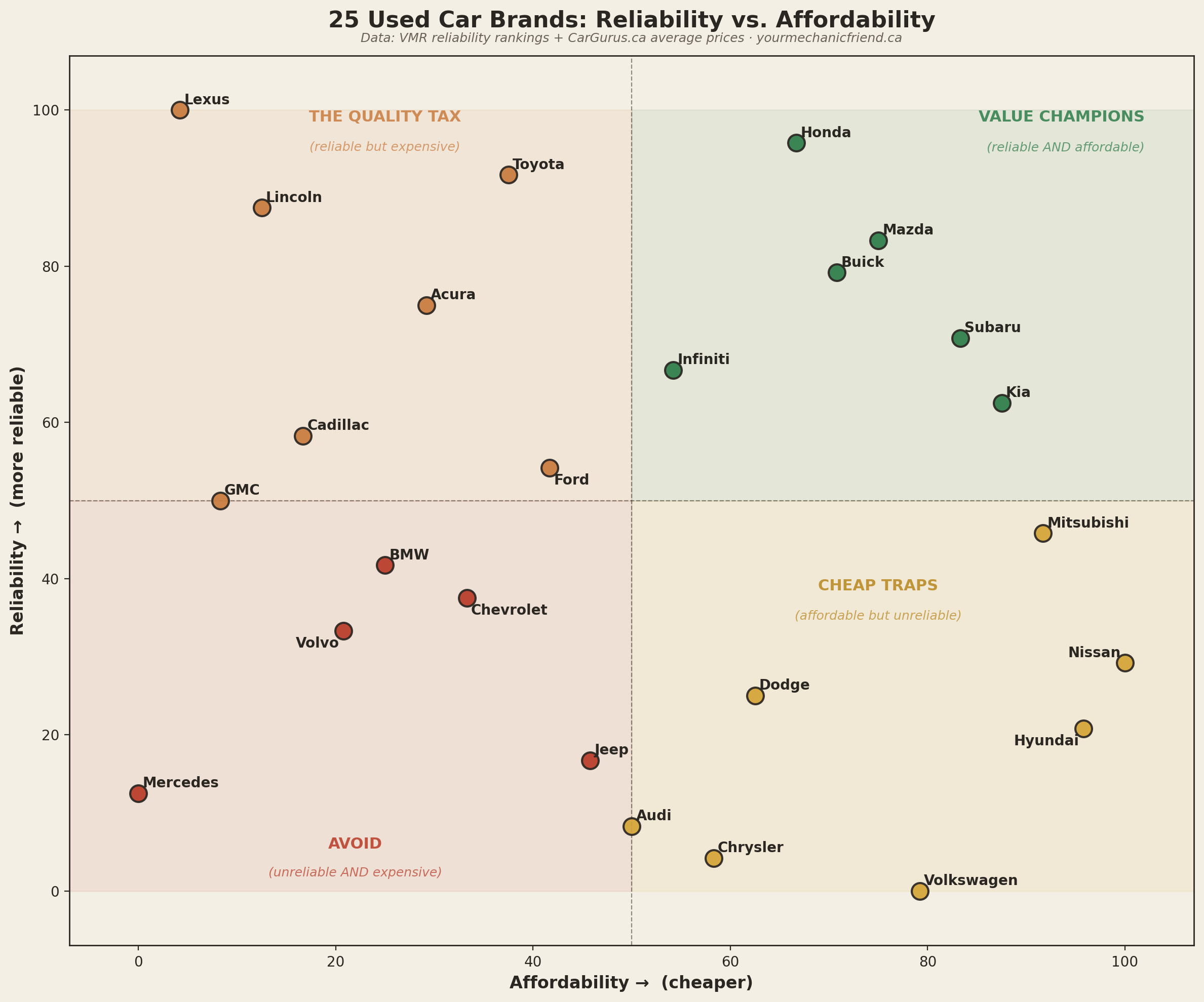
The four quadrants. Top-right is where you want to be. Bottom-left is where Mercedes lives.
The Full Ranking
| # | Brand | Avg Price | Reliab. | R-pct | A-pct | Score |
|---|---|---|---|---|---|---|
| 1 | Honda | $27,867 | 3.48 | 95.8 | 66.7 | 81.2 |
| 2 | Mazda | $26,601 | 3.40 | 83.3 | 75.0 | 79.2 |
| 3 | Subaru | $25,793 | 3.30 | 70.8 | 83.3 | 77.0 |
| 4 | Buick | $27,166 | 3.38 | 79.2 | 70.8 | 75.0 |
| 5 | Kia | $23,607 | 3.17 | 62.5 | 87.5 | 75.0 |
| 6 | Mitsubishi | $23,534 | 3.00 | 45.8 | 91.7 | 68.8 |
| 7 | Nissan | $23,218 | 2.90 | 29.2 | 100.0 | 64.6 |
| 8 | Toyota | $35,019 | 3.47 | 91.7 | 37.5 | 64.6 |
| 9 | Infiniti | $31,753 | 3.29 | 66.7 | 54.2 | 60.5 |
| 10 | Hyundai | $23,235 | 2.75 | 20.8 | 95.8 | 58.3 |
| 11 | Acura | $35,861 | 3.33 | 75.0 | 29.2 | 52.1 |
| 12 | Lexus | $45,103 | 3.67 | 100.0 | 4.2 | 52.1 |
| 13 | Lincoln | $42,597 | 3.42 | 87.5 | 12.5 | 50.0 |
| 14 | Ford | $34,756 | 3.04 | 54.2 | 41.7 | 48.0 |
| 15 | Dodge | $30,089 | 2.84 | 25.0 | 62.5 | 43.8 |
| 16 | Volkswagen | $26,350 | 2.67 | 0.0 | 79.2 | 39.6 |
| 17 | Cadillac | $42,543 | 3.14 | 58.3 | 16.7 | 37.5 |
| 18 | Chevrolet | $35,637 | 2.95 | 37.5 | 33.3 | 35.4 |
| 19 | BMW | $40,354 | 2.96 | 41.7 | 25.0 | 33.4 |
| 20 | Chrysler | $31,599 | 2.68 | 4.2 | 58.3 | 31.2 |
| 21 | Jeep | $34,053 | 2.74 | 16.7 | 45.8 | 31.2 |
| 22 | Audi | $33,079 | 2.73 | 8.3 | 50.0 | 29.1 |
| 23 | GMC | $44,779 | 3.02 | 50.0 | 8.3 | 29.1 |
| 24 | Volvo | $40,639 | 2.93 | 33.3 | 20.8 | 27.0 |
| 25 | Mercedes | $46,236 | 2.74 | 12.5 | 0.0 | 6.2 |
R-pct = reliability percentile (100 = most reliable). A-pct = affordability percentile (100 = cheapest). Score is the average of both.
Does the Japanese Reliability Hype Hold Up?
Here's where my hunch met the data. VMR's reliability data alone tells a clear story: 7 of the top 10 most-reliable brands are Japanese. The remaining three are 2 American (Lincoln and Buick) and 1 Korean (Kia). No European brand cracks the reliability top 10. VMR's own conclusion is straightforward: the Japanese auto industry still sets the standard for reliability.
So far, my loyalty looked backed by the data. But the more interesting question for someone actually buying a used car isn't "which brand is most reliable in isolation?" It's "which brand gives you the most reliability for the dollar?" That's where price comes in, and where things get interesting.
Here's the top 10 when you factor in price:
- The Japanese share stays at 7/10 (Honda, Mazda, Subaru, Mitsubishi, Nissan, Toyota, Infiniti)
- The American share drops from 2 to 1 (Buick stays, Lincoln falls out because it's expensive)
- The Korean share doubles from 1 to 2 (Kia stays, Hyundai joins because it's the cheapest brand in the entire dataset)
- No European brand appears in the top 10 either way
The cars that drop out when price is factored in: Lexus, Acura, Lincoln. All three are reliable but expensive. The cars that enter: Mitsubishi, Nissan, Hyundai. All three are cheap enough that their average reliability becomes great value.
Translation: the Japanese reliability dominance is real, and it survives the price-adjusted analysis. My loyalty wasn't misplaced. But the Korean brands are the real underrated story. Kia and Hyundai have closed the reliability gap enough that their price advantage makes them some of the smartest value plays on the entire chart for budget-conscious buyers. American mass-market brands (Ford, GMC, Chevy, Chrysler, Dodge, Jeep) don't make a single appearance in either top 10. Neither do any of the European luxury brands (Mercedes, BMW, Audi, Volvo).
The conclusion is the same as VMR's, just sharpened: Japanese reliability is real, Korean value is the underrated bet, and the rest of the world is mostly paying for a badge.
What the Data Says
Tier 1: The Value Champions
HONDA · MAZDA · SUBARU · BUICK · KIA
These five brands hit the sweet spot: top-half reliability AND below-average prices. If you're shopping for a used car and you don't know where to start, this is your shortlist.
Honda is the clear winner. Reliability score of 3.48 (second only to Lexus), priced like a Mazda. The Honda V6 has known timing chain stretch issues on certain years, and the older CVTs need fluid changes nobody does, but the small-engine 4-cylinders are still some of the most bombproof powertrains on the road.
Mazda is the underrated answer. Their reliability has quietly climbed since they ditched Ford's parts bin in the mid-2010s. A used Mazda3 or CX-5 is one of the best buys in the entire dataset, and they hold their value reasonably well too.
Subaru is great except for the famous head gasket lottery on older models. Budget for a head gasket replacement on anything 2011 and earlier. After that they got their act together, and the AWD is a genuine value for BC winters.
Buick is the surprise on the list. Older-buyer demographic means most Buicks have been babied. Easy parts availability, decent reliability scores, low prices. A 2015 Encore or Enclave is a quietly smart used buy.
Kia deserves more respect than it gets. Hyundai-Kia have made enormous quality strides in the last decade. Watch out for the Theta II engine in 2011-2018 Optimas and Sorentos (there's a class-action recall), but otherwise they hold up.
Tier 2: The Quality Tax
TOYOTA · ACURA · LEXUS · LINCOLN
These brands are genuinely reliable, but the market knows it, and you pay for it. The question is whether the premium is worth it.
Toyota's reliability score is 3.47, essentially identical to Honda's 3.48. But Toyota's average price is $7,000 higher. That's the Toyota tax. As a Toyota loyalist, this one stung to find. The peace of mind, the resale value, the ironclad reputation are all real, but the data says you're paying meaningfully more for reliability that Honda matches almost exactly. For some buyers, that's worth it. For most of my clients, it isn't. A Honda gets you the same reliability for thousands less. My Hilux Surf isn't going anywhere, but if I were starting fresh with someone else's money on a daily driver, I'd be very hard-pressed not to recommend the Honda.
Lexus tops the entire reliability table at 3.67. It's the most reliable mass-market brand in North America, and 78% of owners rate it "excellent." It's also the most expensive on this list at an average of $45,000. If you can find an older Lexus (2010-2014) at a fair price, the value math actually works. The new ones, less so.
Acura is Honda with a leather interior and a luxury tax. Pay the Acura premium if you want the better interior and don't care about the badge. Otherwise just buy the Honda.
Lincoln at #13 surprised me. Their reliability score is high (3.42) but they're rare enough on the used market that prices stay propped up. Parts availability isn't quite as wide as Ford. Niche pick.
Tier 3: The Average Bets
MITSUBISHI · NISSAN · INFINITI · HYUNDAI · FORD · DODGE · VOLKSWAGEN
This is the murky middle. These brands aren't bad buys, but they're not optimal buys either. The right pick within this tier depends entirely on which specific model you're looking at.
Ford trucks (F-150) are completely different beasts than Ford small cars (Focus). Same brand, dramatically different reliability profiles. The brand average obscures both. Ford does trucks better than they do small cars.
Nissan's CVT problems in 2013-2018 sedans are real and well-documented. Avoid those years. A 2019+ Rogue or Sentra is a different story.
Hyundai looks low on reliability percentile but is dirt cheap. If you're on a tight budget and pick the right year/model, the value math still works. Their 5-year warranty is also genuinely useful on certified pre-owned.
Volkswagen has the lowest reliability score on the entire chart (0.0 percentile). Buy a VW for the driving experience, not for reliability. Budget aggressively for repairs after year 8.
Tier 4: The Avoid List
CADILLAC · CHEVROLET · BMW · CHRYSLER · JEEP · AUDI · GMC · VOLVO
These are the cars that look good on paper but tend to disappoint over time, OR they're priced like they're luxury without the reliability to back it up.
BMW and Audi off-lease in years 4-7 are some of the cheapest cars I see on Marketplace, but the repair bills bring those "deals" right back to break-even. A $4,000 BMW with a check engine light is a $9,000 BMW after the first repair. People don't price that in.
Jeep Grand Cherokee, Wrangler, and Cherokee have wildly different reliability profiles. The Wrangler is a tank; the Cherokee 2014-2019 had transmission issues that bankrupted owners. The brand average reflects that mess.
Volvo is the saddest one for me. Reputation for safety and longevity, but the data says modern Volvos aren't holding up well, and the parts are stupidly expensive when they break. The reliability scores have been trending down.
GMC at #23 surprised me on the bad side. The trucks are mechanically similar to Chevy Silverados, but priced like luxury vehicles. You're paying for the badge.
Tier 5: Mercedes, Alone in the Corner
MERCEDES-BENZ
Mercedes earned its own tier. Combined score of 6.2 out of 100. The lowest reliability among traditional luxury brands AND the highest average price in the dataset. It is, by this analysis, the worst value-per-reliability buy in the used car market.
The 2008-2018 Mercedes lineup has had a brutal reputation among independent mechanics. Air suspension failures, command system glitches, transmission valve body issues, oil leaks at the timing cover, electrical gremlins that defeat dealer techs. Repair bills routinely run $2,000-5,000 per visit.
If you absolutely must own a Mercedes, do it through a lease or while it's still under warranty. The off-warranty used Mercedes is one of the most expensive ownership experiences in the entire auto market. The data agrees, my mechanic friends agree, and every single used Mercedes I've ever inspected has agreed.
So Where Should You Actually Look?
If you're shopping in the next 30 days, here's the cheat sheet from this analysis:
- Best overall value: Honda. Same reliability as Toyota, thousands less.
- Underrated: Mazda. Quietly excellent on both reliability and price.
- If you want AWD: Subaru, with head gasket budget for older models.
- If you want a luxury feel without bankruptcy risk: Buick or Acura.
- If you want a truck: Toyota Tacoma if you can afford it; Ford F-150 or GMC Sierra otherwise.
- If you're on a tight budget: Kia or Hyundai, but research the specific model and year.
- What to avoid: Mercedes, BMW, Audi off-warranty. Cheap Jeeps. Anything with "Cherokee" in the name from 2014-2019.
The bigger takeaway from all this: brand reputation lags reality by 5-10 years. Toyota's reputation was built in the 90s and 2000s when their reliability was 30% better than the competition. Today, the gap has narrowed to almost nothing, but the price premium hasn't. Honda quietly caught up. Mazda quietly caught up. Kia and Hyundai are catching up now. The buyers paying the Toyota tax are paying for yesterday's data.
And the cars people romanticize as "engineered to last" (the German luxury sedans, the body-on-frame American SUVs) have, on average, gotten less reliable as they've gotten more electronically complex. The data shows it. The repair shops confirm it. Your wallet will too, if you don't pay attention.
Caveats
A few things this analysis doesn't capture, that you should weigh too:
- Model-specific variation. A Honda Pilot V6 with cylinder deactivation is not as reliable as a Honda Civic. A Ford F-150 with the 5.0 V8 is not the same as a Ford Focus with the dual-clutch. Use this as a first filter, not a final answer.
- Parts and repair cost differences. A "reliable" car that costs $1,500 every time anything breaks is worse than a "less reliable" car that costs $200. European brands rank lower partly because their parts are expensive when things go.
- Owner maintenance history. A neglected Lexus is worse than a well-maintained Volkswagen. The buyer in front of you matters as much as the brand.
- Specific year issues. Every brand has bad years. Toyota Tacomas have had frame rust issues. Hondas have had Takata airbag recalls. Subarus have had head gaskets. Always check the specific year/model before buying.
The data here is the start of the conversation, not the end.
Thinking about buying a used car?
I help people in Vancouver buy used cars privately without getting burned. Engineering background, F1 race experience, years of hands-on private buying expertise. Listings reviewed from $50.
Reliability data: VMR's Owner Reliability Survey. Price data: CarGurus.ca brand-level averages, current as of May 2026. Analysis and commentary: Dawson March. This is one buyer's framework, not professional financial or legal advice.